Introduction
Navigating through the intricacies of budget planning for demand generation programs can be daunting. However, with a clear understanding and strategic approach, you can efficiently allocate your budget to maximize its potential, ensuring every dollar is well spent.
Mastering Your Messaging Mix for B2B SaaS Demand Generation
The first crucial step in budget planning for demand generation is understanding your messaging mix. It’s essential to determine the frequency and type of messages you intend to convey to your target audience. Consider the various messages you’ll present, from social proof like case studies and testimonials to educational resources and product marketing materials. Each message type plays a pivotal role in engaging and converting your audience.
Identifying Audience Size
Audience size significantly influences your budget. Knowing your target audience’s size and characteristics allows for more precise budget allocation. Consider segmenting your audience based on company size, employee roles, or personas to craft messages that resonate more effectively with each group. This segmentation not only aids in budget planning but also enhances the impact of your messaging mix.
CPM Cost in Demand Generation Planning
CPM is the cost of 1,000 ad impressions, not 1,000 unique people. At a $6 CPM, 1,000 impressions cost $6; 10,000 impressions cost $60. Platform forecasts are estimates and actual delivery costs vary.
Crafting Your Demand Generation Budget
A practical media-spend estimate is: audience size × intended reach share × average frequency ÷ 1,000 × CPM. Choose one planning period for every input. A 20% reach share is an assumption you can test, not a universal target.
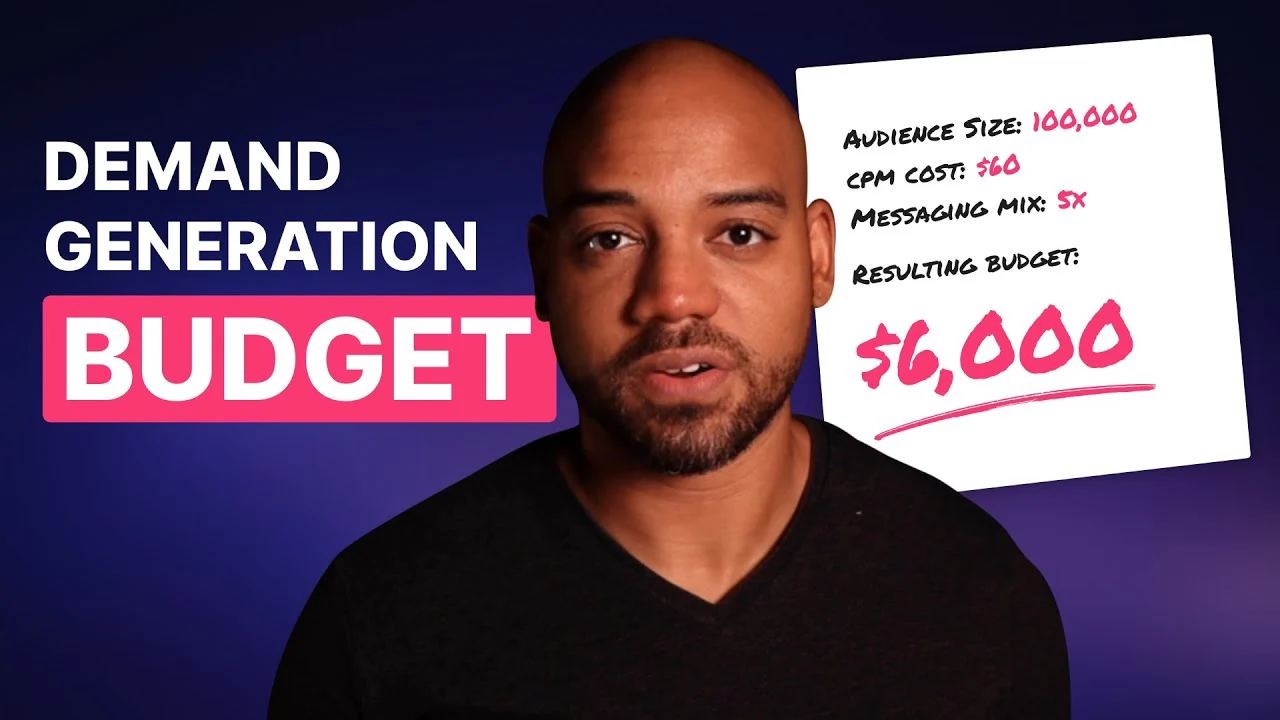
For an illustrative monthly plan with 100,000 people, 20% intended reach, five impressions per reached person, and a $60 CPM, estimated media spend is $6,000: 100,000 × 0.20 × 5 ÷ 1,000 × $60. With only 1,000 people and the same assumptions, the estimate is $60. These figures exclude creative, landing pages, management, and other delivery costs.
| Input | Example | Meaning |
|---|---|---|
| Audience | 100,000 people | Defined addressable audience |
| Reach share | 20% | 20,000 people reached |
| Frequency | 5 | 100,000 total impressions |
| CPM | $60 | Assumed cost per 1,000 impressions |
| Media spend | $6,000 | 100,000 impressions ÷ 1,000 × $60 |
Optimizing Your Demand Generation Budget with Limited Resources
If your available budget is below the calculated demand generation budget, consider refining your audience selection. Narrowing down your audience allows you to maximize the impact of your campaign while staying within budget constraints. This approach ensures that you can effectively reach and engage your target audience without overspending.
B2B SaaS Marketing: A Special Consideration
When it comes to B2B SaaS marketing, budgeting takes on a unique dimension. The SaaS industry is characterized by rapid growth, high competition, and a recurring revenue model. Therefore, it’s essential to allocate a significant portion of your budget to demand generation to stay ahead of the competition.
Consider investing in advanced analytics tools to track user behavior and engagement. This data can provide insights into which marketing strategies are most effective, allowing for better budget allocation. Additionally, prioritize content marketing, as it’s a cost-effective way to engage potential customers and position your SaaS product as a solution to their problems.
The Role of B2B SaaS Demand Generation
Demand generation in the B2B SaaS space is about more than just creating awareness. It’s about building genuine interest and driving potential customers down the sales funnel. This requires a well-thought-out strategy and a significant budget allocation.
Focus on creating high-quality content that addresses the pain points of your target audience. Webinars, whitepapers, and case studies can be particularly effective in this space. Additionally, invest in targeted advertising campaigns on platforms frequented by your target audience, such as LinkedIn.
Conclusion
Budget planning for demand generation programs doesn’t have to be complex. By understanding your messaging mix, identifying your audience size, calculating CPM costs, and optimizing your resources, you can craft a budget that maximizes every dollar spent.
Ready to launch a successful demand generation program for your B2B SaaS company? Schedule a free 30-minute growth blueprint to explore your growth opportunities.
Demand generation budget FAQs
How much should a B2B SaaS company spend?
There is no universal budget. Start with the audience, delivery costs, and frequency needed to test your message, then check whether acquisition costs and sales capacity make the plan viable.
Does this formula predict leads or revenue?
No. It estimates media delivery. Forecasting qualified leads or revenue also requires conversion rates, sales-cycle assumptions, and close rates supported by your own data.
What should change when the budget is limited?
Narrow the audience or channel scope and prioritize a smaller number of useful messages. Keep enough budget to evaluate the chosen audience rather than spreading spend across too many experiments.