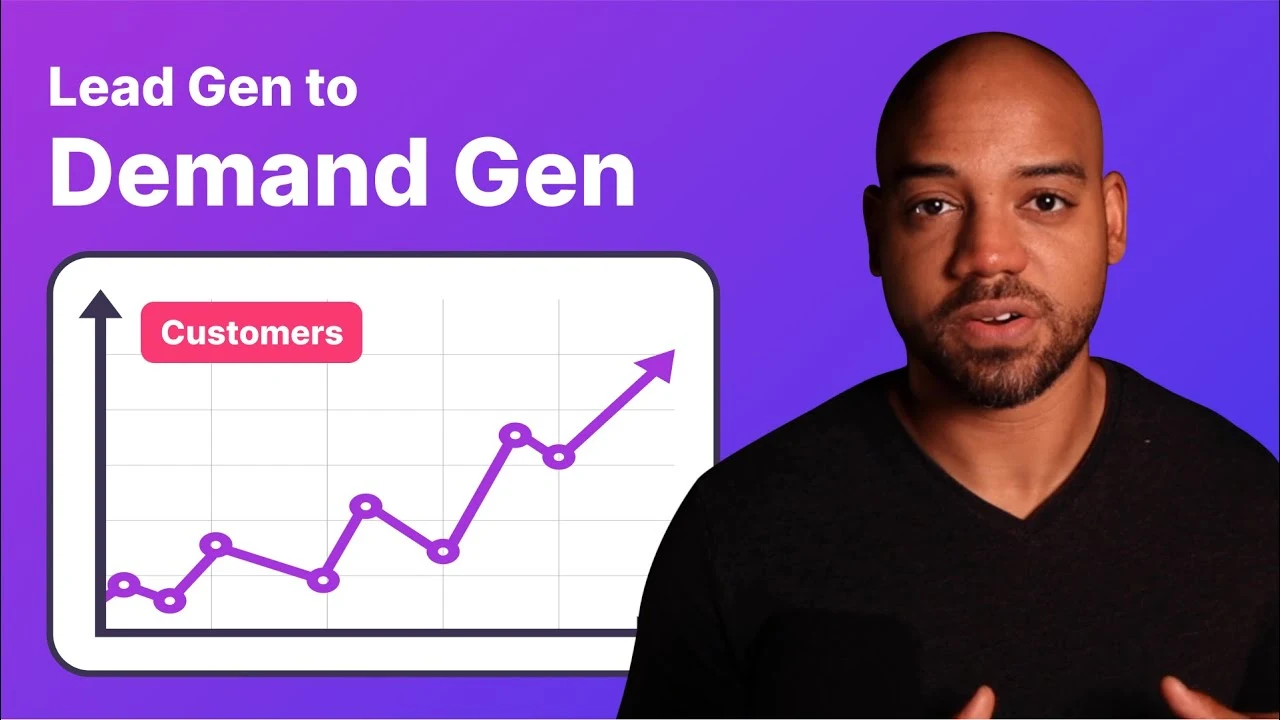
Switching to demand generation changes what a marketing team needs to learn. A larger contact list may still have value, but it cannot tell you whether the right buyers understand the product or see a reason to consider it.
The accompanying video presents three ways to evaluate that shift: message resonance, visibility with the intended audience, and progress through the sales cycle. Together, they provide a better picture than lead volume alone.
Lead generation and demand generation: what changes in measurement?
| Question | Lead capture measure | Broader demand generation check |
|---|---|---|
| Are people responding? | Inquiries or form submissions | Relevant questions and engagement with the message |
| Are we reaching buyers? | Fit of captured contacts | Fit of the audience reached, including people who have not inquired |
| Does activity progress? | Lead-to-meeting and opportunity rates | Progression of informed buyers through the same sales stages |
| Is the program commercially useful? | Acquisition cost and closed outcomes | Acquisition cost and closed outcomes, evaluated over a suitable sales window |
These measures complement each other. Early engagement adds context; it does not replace commercial outcomes.
1. Look for a message that resonates
Start by asking whether the content creates meaningful engagement among people who fit the customer profile. Relevant questions, thoughtful comments, and sharing can help reveal what the audience finds useful.
The distinction is who is engaging and why. A post that attracts broad attention may not address the problem your buyer needs to solve. Use the response to improve the message rather than treating every interaction as equally valuable.
This sits within a broader demand generation framework, where content helps buyers learn before they are ready for a sales conversation.
2. Check whether the right people see it
Distribution should reach the roles and organizations that matter to the business. Review audience fit alongside reach.
For a hypothetical software company selling to operations teams, attention from unrelated job functions may do little to advance the campaign’s goal. The company needs to know whether relevant accounts and decision-makers are being reached, not simply whether impressions increased.
Use the audience information available to you, and be clear about what it can and cannot establish. Exposure is a useful input, not proof of a buying decision.
3. Follow the effect on sales progress
The video’s final area is sales velocity. Buyers who understand the problem and the product may arrive at a conversation better prepared, but a shorter sales cycle should be evaluated rather than promised.
Compare cohorts over a period appropriate to your actual sales process. Look at qualification, attendance, opportunity progression, and closed deals. Also examine whether changes in audience or deal size explain differences in timing.
The B2B marketing funnel guide explains how educational and conversion-focused activity support different buyer needs.
Takeaway: change the scorecard with the strategy
Keep lead capture where it serves the buyer, but stop using the size of the list as the entire scorecard. Pair evidence of audience relevance with downstream sales outcomes.
Watch the original discussion of lead generation and demand generation on YouTube.
FAQ
Does demand generation replace lead generation completely?
Not necessarily. Useful lead capture can remain part of the process. The change is to evaluate it within a broader effort to create understanding and demand.
Are engagement metrics enough to prove success?
No. They can show early resonance, but they need to be interpreted alongside audience fit and later commercial outcomes.
Will demand generation always shorten the sales cycle?
No. It can help buyers become better informed, but sales timing also depends on the product, organization, buying process, and market conditions.
Want a scorecard that reflects more than lead volume? GET MY FREE PIPELINE AUDIT.