A useful B2B cost per lead target starts with the value of a customer and the rate at which leads become customers. A competitor’s CPL or a platform average cannot tell you what your own funnel can support.
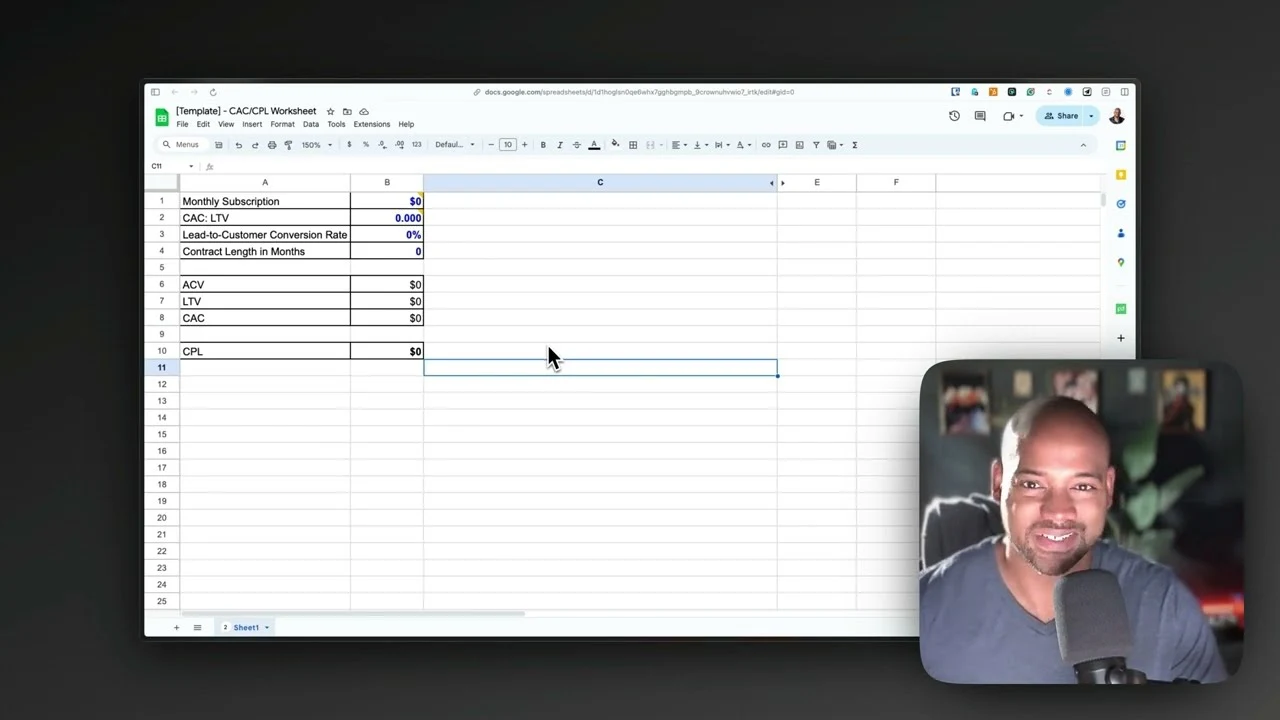
The source video walks through a simple planning worksheet. Its core idea is to work backward from customer economics, make the assumptions visible, and replace estimates with actual results as data becomes available.
Start with customer value and an acquisition allowance
Record your average contract value, expected customer duration, and the acquisition cost your business can support. Keep the definitions consistent: annual contract value, lifetime revenue, and gross profit are different measures.
The video uses a simplified lifetime-value-to-acquisition-cost model. Treat that as a starting model, not a universal spending rule. Your own allowance also needs to reflect the economics and operating costs of serving a customer.
Be explicit about what is included. An advertising-only acquisition cost is not the same as a fully loaded cost that includes sales and marketing labor, tools, and other expenses.
Work backward to cost per lead
Once you have an acquisition allowance for the costs being modeled, multiply it by the expected lead-to-customer conversion rate:
Target CPL = acquisition allowance per customer × lead-to-customer conversion rate.
For a hypothetical example, assume the allowable advertising cost is $6,000 per acquired customer and 10% of the relevant leads become customers. The implied advertising CPL ceiling is $600. If the actual conversion rate is 5%, that ceiling falls to $300.
| Illustrative advertising allowance per customer | Assumed lead-to-customer rate | Implied advertising CPL ceiling |
|---|---|---|
| $6,000 | 10% | $600 |
| $6,000 | 5% | $300 |
These are illustrative assumptions, not recommended budgets. They show why a CPL target must move with conversion performance.
Use comparable leads and a complete sales window
A resource download and a qualified demo request may convert at very different rates. Combining them into one average can produce a target that is unsuitable for either campaign.
Segment the model where the buying journey differs. Compare the same lead definition, channel, and time period, and allow enough time for the cohort to move through the sales cycle. Our B2B demand generation budget guide provides broader context for allocating spend around the acquisition program.
Your next step: compare the model with reality
Create a worksheet with assumptions beside actual results: customer value, acquisition allowance, lead conversion, and observed CPL. Review the gaps with sales before increasing spend.
If the numbers do not work, investigate whether the issue is lead quality, progression, sales conversion, or the original economic assumptions. The B2B marketing lessons guide explains why measuring the full journey matters.
Watch the source worksheet walkthrough: What Should You Budget for B2B Customer Acquisition?.
Frequently asked questions
Is a lower CPL always better?
No. A more expensive lead can be more economical if it converts into a customer at a sufficiently higher rate. Evaluate the downstream outcome using comparable cohorts.
What if we do not know our lead-to-customer conversion rate?
Use an explicit planning assumption, show more than one scenario, and label the target provisional. Replace the estimate as real cohorts mature rather than treating the first spreadsheet output as a fixed benchmark.
Need help connecting your ad budget to pipeline performance? GET MY FREE PIPELINE AUDIT.