A clinician with a relevant, engaged professional audience can help a healthtech company start conversations that a product advertisement struggles to open. The useful question is not simply who has the largest following. It is who reaches the people you need to educate and can speak credibly about the problem your product addresses.
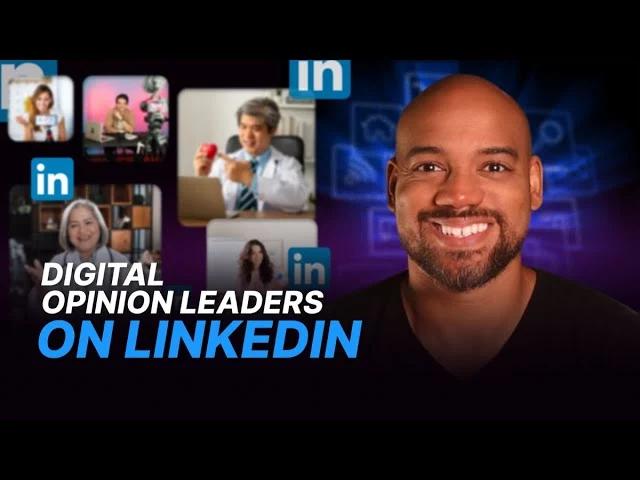
In the source conversation, Orrett Davis and his co-host discuss using LinkedIn content and paid distribution to identify and support digital opinion leaders. Their approach connects audience research, content development, controlled advertising tests, and relevant follow-up.
For a healthtech team, this is a way to develop relationships and market understanding. It should sit inside a broader demand generation program, with clear boundaries between content engagement and qualified commercial interest.
1. Understand the difference between a KOL and a DOL
A key opinion leader, or KOL, may be known through research, conference presentations, institutional leadership, or professional reputation. A digital opinion leader, or DOL, develops influence through online content and interaction.
The same person can be both. But a strong conference profile does not automatically mean an active, relevant LinkedIn audience, and a useful digital voice does not have to be a regular keynote speaker.
Evaluate the role you need the person to play. Conference credibility, peer education between events, product feedback, and digital content distribution are related but different jobs. Your selection criteria should reflect the actual job.
2. Select for audience fit before follower count
Start with the professionals you need to reach. Be specific about specialty, role, practice setting, organization type, and buying influence.
Then review a potential partner’s public content and engagement. Look for evidence that the right people are reading, responding, and returning to the conversation. A broad audience can be less relevant to a niche device or software category than a smaller community with a close professional fit.
Useful questions include:
- Do the people engaging match the audience we want to educate?
- Does the person already discuss the problem or field we work in?
- Are their posts substantive enough to start useful conversations?
- Are they willing to collaborate on clear, accurate content?
- Does their experience support the points they would be making?
The conversation also distinguishes early technology enthusiasts from people who prefer more established solutions. That is useful when selecting participants for an early-market discussion, but enthusiasm should never substitute for evidence behind a product claim.
3. Build the post around the practitioner’s perspective
The strongest starting point is a real professional experience or a specific problem. Help the contributor explain it clearly without putting unsupported claims or experiences in their voice.
A practical content outline is:
- Identify the professional role or situation the post addresses.
- Explain the problem in terms that audience recognizes.
- Describe the relevant experience, observation, or decision.
- Give the reader a useful lesson or next question.
The source conversation emphasizes making the person the focal point of the creative. A relevant photograph can provide context that a polished product render does not. The content should still accurately represent what was observed and what the product can support.
If your team helps draft or edit, the contributor should review and approve the words attributed to them. Keep that approval separate from permission to promote the content as advertising.
4. Observe the organic response before adding paid distribution
An organic post can reveal whether the topic resonates with the intended audience. Review the quality of responses, not only the total number of likes.
A thoughtful comment from someone in the target specialty may be more useful for learning than broad engagement from unrelated accounts. Look for questions, objections, and signs that readers understand the problem being discussed.
Use those observations to decide what deserves more distribution. Paid reach can put a useful post in front of more relevant people; it cannot turn an unclear or unsupported message into a strong one.
This content belongs within the larger demand generation framework for B2B SaaS and health companies, which combines education, proof, and opportunities to take the next step.
5. Give the paid test one clear objective
The video discusses awareness and engagement as possible objectives for this kind of content. Choose the question the test is meant to answer before selecting the campaign configuration.
For example, a hypothetical test could ask whether a practitioner-led explanation reaches the right specialty and prompts relevant discussion. That is different from asking whether a landing page generates qualified demo requests.
Keep those tests separate. Otherwise, a campaign that produces many easy engagement actions can obscure the performance of a campaign meant to produce website conversions.
Set a defined budget, an end date, and a review plan. Check these settings when creating or duplicating a campaign. The operating principle is a bounded experiment with an explicit learning goal.
6. Keep targeting connected to the actual buying audience
The conversation highlights LinkedIn’s professional audience criteria and exclusions. Use them to express the market you have chosen, rather than accepting every suggested role simply to enlarge the audience.
A healthtech audience may span practice settings and institutions. For example, academic physicians may appear in a different organizational category from clinicians in private practice. Think through these differences before assuming that a broad industry label covers everyone you need.
At the same time, avoid narrowing so aggressively that a campaign cannot reach a workable audience. Review delivery and relevance together. If testing broader distribution, isolate that experiment so you can see whether it changes the quality of engagement.
7. Turn engagement into relevant follow-up
A like is a sign of interaction, not proof that someone wants a sales call. Use engagement as a starting point for research and context.
The source discussion suggests looking for relevant professionals who repeatedly engage and considering whether an introduction or useful resource is appropriate. The next step should match what the person actually expressed.
For a hypothetical reader asking a technical question, a clear answer or relevant demonstration may be useful. Someone merely liking a post may need no immediate outreach at all. Distinguishing these situations helps keep follow-up thoughtful.
Where conversations do progress, record what happened. Track relevant responses, introductions, meetings, and opportunities as separate outcomes. That provides a more useful account of the program than a single engagement total.
8. Keep building education beyond product proof
Practitioner content can give an interested audience a reason to investigate. It does not remove the need to explain the underlying problem to people who are less familiar with the category.
A balanced program includes useful problem-focused content, product explanations, and credible proof. Our guide to the B2B tech marketing funnel shows how these jobs fit together.
Continue producing educational material even when a product-focused post performs well. One successful post does not mean the market is already familiar with your offering, and one opinion leader does not represent every buying group.
The content distribution guide can help turn an approved practitioner conversation into useful excerpts and a repeatable publishing process.
Your next step: design a small, measurable pilot
Choose one audience, one relevant contributor, and one topic grounded in their experience. Agree on the content and promotion permissions, publish, assess the response, and decide whether a paid test is justified.
Before spending, write down the intended outcome and what would cause you to stop, revise, or expand. Review audience relevance and the quality of the resulting conversations, then use those findings to improve the next piece of content.
Watch the complete conversation: Proven LinkedIn Strategies to Attract and Nurture Digital Opinion Leaders in HealthTech.
Frequently asked questions
Does a digital opinion leader need a large following?
No. Relevance, credibility, and audience engagement can matter more than the total follower count. Review who participates in the conversation and whether those people match the professionals your business needs to reach.
Should DOL content send every reader directly to a demo?
Not necessarily. A post may be intended to educate or invite discussion. Match the next step to the content’s purpose and the reader’s level of interest, then measure demo conversion separately when that is the objective.
Can a company help a clinician write a LinkedIn post?
A team can help organize and edit content, but the clinician should approve the statements attributed to them. Preserve the person’s actual experience and obtain the necessary permission before using the content in paid promotion.
What should we measure beyond likes?
Review audience fit, substantive comments, relevant questions, introductions, and subsequent conversations. Track meetings and opportunities separately so engagement is not mistaken for qualified pipeline.
Want to connect practitioner content with a broader acquisition program? GET MY FREE PIPELINE AUDIT.